

Digitizing books, manuscripts and archives requires precise tools that ensure not only high image quality, but also the security of the collections themselves. Choosing the right scanner is a strategic decision because it directly affects the fidelity of reproduction and the speed of work. What to pay attention to when buying?
Resolution (DPI), the foundation of quality
Optical resolution, expressed in DPI, determines the number of image dots per inch and directly determines the level of detail. Only the optical resolution (not interpolated) counts, because it shows the actual capabilities of the sensor.
For digitizing standard books and documents, 300 DPI is usually sufficient, but for manuscripts, old prints, maps or scientific photographs, it is worth reaching for 400–600 DPI or even higher if you want maximum fidelity. Higher resolution means better readability, more accurate capture of details (e.g. paper texture or fine lines of a drawing), more effective OCR, and greater potential for future analysis and larger enlargements.
Safe lighting in the protection of monuments
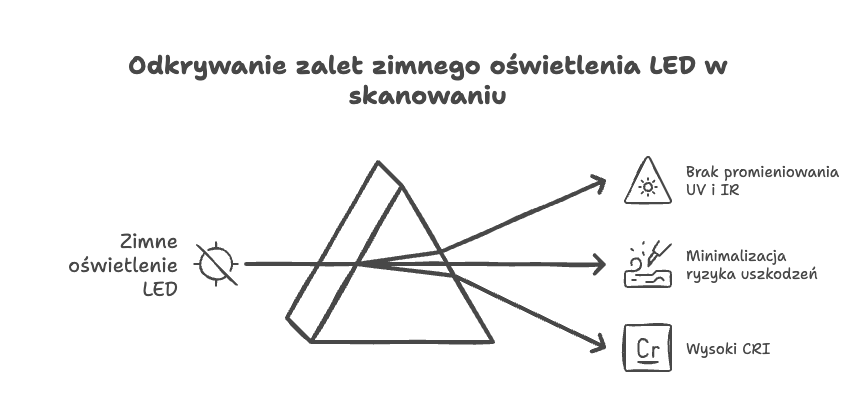
Professional scanners use cold LED lighting, free of UV and IR radiation that could damage paper or pigments. This type of light minimizes the risk of fading, drying out and chemical degradation of materials, which is extremely important when working with valuable collections.
The key factor is also the color rendering index (CRI) above 90, and in top models even reaching 95. – ensuring faithful color reproduction compared to natural lighting. This is particularly important when scanning maps, illustrations or materials where color has scientific or conservation significance.
V-cradle vs. flat surface
Professional book scanners feature a planetary design that minimizes contact with delicate items. A V-shaped cradle is essential. – allows scanning at an angle, reducing stress on the spine and protecting the binding from damage.
Advanced models feature pressure adjustment and thickness compensation, allowing for perfect adjustment to a specific copy. A platenless mode is often also available, which is particularly useful when digitizing old prints and tightly bound manuscripts. This ensures more faithful reproduction around the spine, while preserving page geometry and fine details to the highest quality.
Speed and efficiency
With mass digitization, time becomes a key resource. The greater the volume of materials, the more critical device performance becomes. Professional scanners can scan in just 1–3 seconds per page, which in practice translates into hundreds or even thousands of digitized pages during a single work shift.
It is also worth taking a look at the level of automation – features such as intelligent cropping, layout recognition, OCR integration or the creation of multi-page files can dramatically speed up the entire process and reduce the need for time-consuming post-processing. In large projects, the difference in the level of automation may determine the implementation time and costs of the project.
Advanced software
Professional scanners are not only hardware, they also have an extensive software environment.
Advanced systems offer, among others:
- correction of page curvature, which allows for the elimination of deformations in the spine area,
- color management and ICC profile support for faithful color reproduction,
- integration with OCR, enabling automatic text recognition and creation of searchable files,
- generating files in archive formats (TIFF) and user formats (PDF/A, JPEG),
- automatic cropping, page layout recognition, spread splitting and operator finger removal.
Such tools not only speed up the preparation of files for archiving or publication, but also allow you to fully utilize the device's potential, improving the quality of final copies and shortening the entire process time.
An2Di Book Scanner A2+
The Polish An2Di Book Scanner A2+ is a compact yet highly efficient solution for libraries, museums, and archives. The device combines high image quality with the security of collections. One-second scanning, UV- and IR-free LED lighting, and a cradle adapted to various book types make it an excellent choice for institutions looking to quickly and securely digitize their collections.
Digitalization as an investment in the future
When choosing a scanner, you cannot base your decision solely on price. Harvest safety, efficiency and imaging quality are key. Resolution, safe LED lighting, V-cradle design, speed of operation and advanced software are the pillars that every professional system should meet.
An2Di Book Scanner A2+ combines these elements, offering institutions the optimal balance between quality, efficiency, and cost. It's an investment that not only preserves heritage but also allows it to be shared digitally for future generations.